Standing Half Forward Fold (Ardha Uttanasana)
Standing Half Forward Fold (Ardha Uttanasana)
Create expansion in the front body and length in the spine. This pose is great to relieve anxiety and get yourself back to deep breathing.
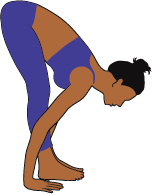
(are-dah oot-tan-AHS-anna)
ardha = half
uttana = intense stretch
asana = posture
Kinda. In a trauma-informed classroom, be sure students are not placed behind others and that you do not walk around the room while students are unable to see your movements. If this pose makes a student uncomfortable, try it with their back against a wall instead.
Pro tip: Use whatever height is necessary to enable you to bring your spine into neutral, including blocks or even the wall. Touching your fingers to the ground in Ardha Uttanasana does not make you a better yogi.
Standing Half Forward Bend (Ardha Uttanasana) Step-by-Step Instructions:
1. Start in Uttanasana, press your palms or fingertips into the ground, blocks or shins
Alternatively you could start in Tadasana, and come to Ardha Uttanasana by rotating forward at the hips. This is useful for students who aren’t quite ready for a full forward fold.
2. Inhale, and lift halfway, working toward straightening your elbows without locking to support the spine. Arms externally rotate, triceps moving back and biceps moving forward
3. Frontal hip bones tilt forward while sitz bones (sitting bones) lift up
You are presenting your booty, in all its glory. Werk.
4. Lengthen from the tailbone through the crown of the head, keeping the natural curves of the spine. Explore bending the knees slightly while lifting the sternum up and forward
Think about rooting down through your feet, lifting up through the sitz bones, then reaching out through the crown of the head, lengthening the spine.
5. Hug the lower belly up and in to engage the core, while maintaining the slight internal rotation of the thighs as in Tadasana
Don’t lock your knees. I did when I first learned these, and what did I get? Pain. Protect those joints!
6. Soften shoulders and traps away from the ears
We’re still breathing deeply, right? Ask yourself what areas you’re tensing, whether they are helping or hurting this posture, and then exhale to release what you don’t need.
7. Gaze forward, without compressing the back of the neck. If you have a neck injury or pain, keep the neck in line with the spine, gaze toward the floor.
8. Breathe
Ah yes, back to the elusive breathing portion. Allow each breath to create length and expansion in your front body, each exhale softens and encourages your body to relax.
9. To release, either fold back into Uttansana with the newly created length, or take your hands to your hips and slightly bend the knees as you lift up into Tadasana or Urdhva Hastasana, keeping the spine long.
Acknowledge how you feel, notice any thoughts that come up, and as you exhale allow them to go.
Focus on Stretching:
The calf muscle is made up of two muscles, the gastrocnemius (forms the visible bulge) and the soleus (smaller and deep, or underneath, the gastrocnemius).
Flexor: a muscle serving to bend a body part
The knee flexors include the hamstrings, gracilis, sartorius, gastrocnemius, plantaris, and popliteus. Most of these knee flexors also internally or externally rotate the knee.
Extensor: a muscle serving to extend a body part
The primary hip extensors are the gluteus maximus (butt) and the hamstrings.
Extensor: a muscle serving to extend a body part
The Back Extensors include the erector spinae, which help hold up the spine, and gluteal muscles.
Elevator: any muscle that serves to raise a part of the body.
Shoulder Elevator muscles include the Levator scapulae, Rhomboid major, Rhomboid minor, and Trapezius.
The chest has several muscles, most well known are the “pecs,” (nice pecs bro!) or Pectoral muscles. Here you’ll also find the Subclavius and Serratus anterior (which according to wiki helps you throw a punch, nice!). The Intercostal muscles between the ribs help with breathing.
Contraindications:
- Sciatic pain, herniated disk
- Back Pain
- With neck pain or injury, keep the neck in line with the spine
- See Modifications below
- If disabled, may be done while seated.
Benefits:
- Stretches the backs of the legs
- Lengthens the spine and neck, improving posture
- Creates space in the upper body, offering a deeper breath
Common Mistakes:
- Not using enough height to encourage a natural curve to the spine
- Tight shoulders and traps
- Holding breath while engaging lower belly/core
Asanas (Postures) for Preparing:
- Bhujangasana (Cobra Pose)
- Bidalasana / Bitilasana (Cat / Cow Pose)
- Dandasana (Staff Pose)
- Supta Padangusthasana (Supine, or reclining, Hand-to-Big-Toe Pose)
- Tadasana (Mountain Pose)
- Uttanasana (Standing Forward Fold)
- Urdhva Hastasana (Mountain Pose with Raised Arms)
Modifications, Variations & Props:
- Feet hip distance apart and parallel for more stability (pregnant, beginner, elder, wide hips, or just because it feels better)
- Place a block between your thighs to understand the leg activation and slight internal rotation
- For stiff legs or tight back, knees bent and/or hands on blocks so the back maintains its natural curve
- For stiffness or back pain, consider an Ardha Uttanasana variation, with hands on the wall toward parallel with the ground, legs perpendicular to your torso
- Place a hand on your pack to feel if your spine has maintained its natural curve. You can also use a mirror (or partner!).
With a Partner:
See Uttanasana.
Partner may place fingers on the frontal hip bones and thumbs on the sacrum, gently rotating the pelvis forward to teach the correct tilt. One hand may be placed on the spine, fingers pointing forward to teach lengthening the spine.
To Stabilize, Focus on Energizing the:
The intrinsic (originating within the body) foot muscles include the abductor halluces, flexor digitorum brevis, abductor digiti minimi, and the quadratus plantae. These are involved in fine motor skills, such as moving the toes.
Focus on spreading the toes wide and grounding through all four corners of the feet.
Knee extension involves making the joint angle larger, or in this case straightening the knee
Focus on lifting the kneecaps and flexing the quads (front thighs) without locking the knees. Micro-bend, people.
Extensor: a muscle serving to extend a body part
The Back Extensors include the erector spinae, which help hold up the spine, and gluteal muscles.
Focus on keeping the spine long with a natural curve to your back.
Extensor: a muscle serving to extend a bodily part
The primary hip extensors are the gluteus maximus (butt) and the hamstrings.
Focus on a slight internal rotation of the thighs, while lengthening your tail up, heels down.
The transversus abdominis is a muscle found on the lateral sides of the abdominal wall.
Fun fact: transversus refers to muscle fibres, which go across. Understanding the direction of muscle fibres can help inform a bomb af massage.
Focus on lifting the lower belly up and in, while still maintaining length in the front body.
Retractor: any muscle that moves an organ or body part in
The Shoulder Retractors include the middle Trapezius Muscle and Rhomboid Muscle.
Focus on pulling your shoulder blades in toward your spine without drawing your shoulders into your ears.
Go Deeper:
Try lifting up the toes to strengthen the inner arches of your feet as you balance in this pose.
What’s Next?
Adho Mukha Svanasana, Padangusthasana, Pada Hastasana, Paschimottanasana
In Sun Salutation A, this pose leads to Chaturanga Dandasana, or Four-Limbed Staff Pose.
Half Forward Fold (Ardha Uttanasana) in a Chair
Inhale and lengthen the sides of your waist, drawing the shoulder blades in toward the spine while releasing the shoulders away from the ears, placing hands on thighs or arm rests. Exhale, and explore the feeling of arching the belly forward while keeping the sternum (chest) lifting and collarbones open. Elbows work toward hugging into the midline. Neck can remain tucked into the chest or, if accessible, gaze may look slightly forward. Breathe here, allowing the face and jaw to soften.
To release, on an inhale press back up to a neutral seated position.
See Uttanasana for a full forward fold while seated.
Recent Posts
- Amara Yoga & Arts Teacher Training 2018, Luna Pierson, Kathryn Fitzgerald and Linda Lehovec
- Yoga Asanas for preparing and stabilizing via The Mark Stephens Yoga Sequencing Deck
(affiliate link)
- Calves defintion via WebMD
- Knee Flexors defintion via Science Direct
- Hip Extensors definition via Jospt
- Back Extensors definition via Spine Health
- Shoulder Elevators definition via Wikipedia
- Intrinsic Foot Muscles definition via Ler Magazine
- Hip Flexors defintion via POSMC
- Definitions Mirriam-Webster
 (affiliate link)